The Role of AI in Label Printing: From Smart Design to Quality Control
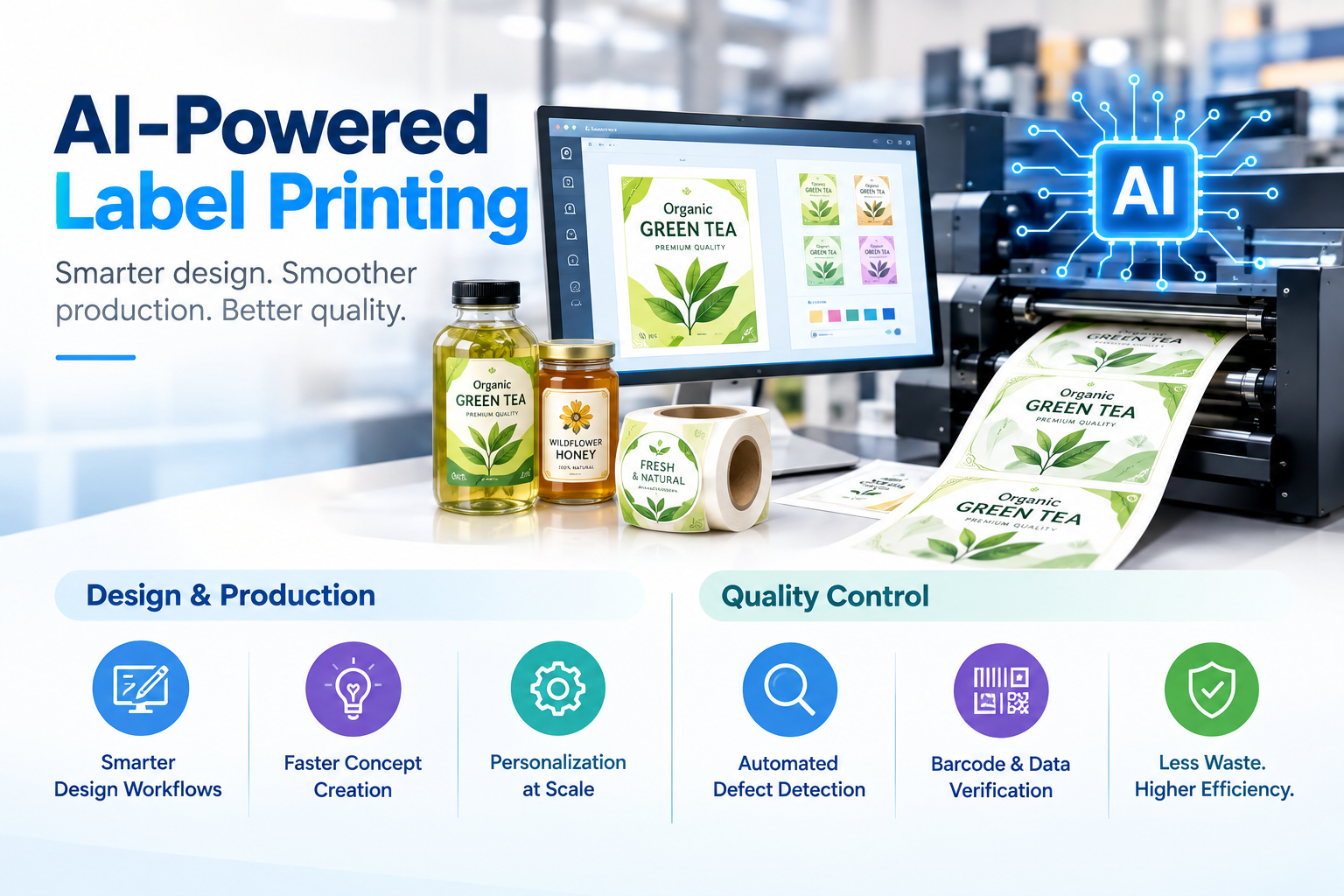
Packaging and labeling operations are under increasing pressure to deliver faster turnaround times, greater customization, higher quality standards, and improved efficiency. AI label printing is emerging as a practical approach to address these demands. By applying artificial intelligence in printing, manufacturers can improve design workflows, automate production tasks, monitor quality, and make better use of production data. As the AI in printing industry continues to evolve, intelligent technologies are becoming increasingly relevant to modern label production. This post how AI is transforming label design, production processes, and quality control.
How AI Is Transforming Label Designing
Here are the key ways AI is transforming label design, generating concepts, optimizing artwork, enabling personalization, and preparing designs for production.
-
AI-Assisted Design Optimization:
Modern AI label design solutions can evaluate layouts, typography, color schemes, spacing, readability, and visual hierarchy to recommend improvements. Designers can quickly explore design variations, refine artwork, and identify potential issues within the design itself. This reduces repetitive work and shortens revision cycles while allowing designers to focus on creative decisions and develop more effective, production-ready label artwork.
-
AI-Generated Design Concepts:
AI can accelerate the early stages of label development by generating initial concepts, layout variations, and visual directions based on defined design requirements. Instead of developing every option manually, designers can use AI to explore multiple possibilities and select promising concepts for refinement. This supports faster ideation while giving creative teams greater flexibility when developing labels for new products or campaigns.
-
Personalization at Scale:
AI enables brands to create customized labels for different markets, regions, campaigns, and customer segments. When combined with variable data printing, it can help create labels containing personalized messages, regional content, promotional offers, or serialized information. This makes large-scale customization more practical while leveraging digital label printing technology to produce multiple label variations without redesigning each version manually.
How AI Improves Quality Control in Label Printing
AI-powered quality control systems can continuously examine production output, identify defects, and verify critical printed information against predefined standards. Here are the key ways AI can improve quality control in label printing:
-
Automated Defect Detection:
AI-powered vision systems can inspect printed labels continuously and detect defects that may be missed through manual inspection or sampling. These systems can identify print defects, color deviations, registration errors, smudging, missing elements, and other visual abnormalities. Detecting defects during production allows operators to respond quickly, preventing large quantities of faulty labels from progressing through the production process.
-
Barcode and Variable Data Verification:
AI inspection systems can verify whether barcodes, QR codes, serialized numbers, and other variable data have been printed accurately and remain readable. Unlike AI-driven personalization, which helps create variable content, quality-control systems verify the final printed result against the expected information. This supports reliable label production, accurate product identification, effective traceability, and consistent scanning throughout the supply chain.
-
Waste Reduction and Process Improvement:
Early detection prevents manufacturers from producing large quantities of defective labels that require disposal or reprinting. AI inspection data can also reveal recurring defect patterns, helping operators identify underlying production problems and improve processes. By correcting issues closer to their source, manufacturers can reduce material waste, rework, production delays, and operating costs while improving overall label production efficiency.
-
Design Compliance and Print Readiness:
AI can evaluate artwork against predefined brand guidelines, regulatory requirements, and technical specifications before it enters production. It can flag issues such as incorrect content, missing elements, unsuitable dimensions, or design elements that may affect printability. This helps teams prepare compliant, production-ready artwork and reduces the risk of errors during the transition from label design to printing
How to Prepare for AI Adoption in Label Printing
Adopting AI in label printing requires careful planning rather than simply adding new technology to existing operations. Businesses should first identify where AI can address genuine production challenges and then assess whether their systems, data, workflows, and workforce are ready for implementation.
Here are the key areas to consider when preparing for AI adoption in label printing:
-
Identify Operational Challenges:
Start by identifying the production challenges you want AI to address. Look for workflow bottlenecks, repetitive tasks, quality issues, scheduling constraints, frequent changeovers, and equipment downtime. This helps prioritize practical applications such as automated label printing and focus investment on areas with clear operational value.
-
Assess Existing Infrastructure:
Review your digital presses, printing equipment, label printing software, workflow platforms, and production systems before introducing AI. Check whether these systems can support AI printing technology and identify any connectivity, compatibility, or technology upgrades required for implementation.
-
Evaluate Data Readiness:
AI requires reliable, accessible data to deliver useful insights. Evaluate how you collect, store, and manage production, equipment, quality, and workflow data. Ensure the information is accurate, structured, and accessible so AI systems can generate dependable analysis and recommendations.
-
Plan System Integration:
Determine how AI will connect with your existing label printing software, digital presses, workflow systems, inspection tools, and production equipment. Define integration requirements early to ensure systems can exchange data effectively and AI becomes part of the existing production workflow rather than an isolated solution.
-
Prepare Employees:
Train designers, press operators, production managers, and technical teams to work with AI-powered tools. Explain how AI will affect existing workflows and responsibilities, and provide practical training on interpreting AI recommendations and using new systems effectively.
-
Choose Scalable Solutions:
Choose AI solutions that meet current requirements while supporting future growth. Consider whether the technology can accommodate additional equipment, production volumes, label formats, workflows, and applications as your operation expands. This provides a foundation for automated label production without requiring major changes as production needs evolve.
Bring Smarter Label Design and Quality Control to Production
As AI continues to reshape label printing, businesses can benefit from faster design workflows, improved print consistency, and smarter quality control. PLCTX helps businesses turn their label requirements into high-quality printed solutions with flexible options for different applications and production volumes. Get in touch with PLCTX to find the right custom label printing solution for your business.