Smart Labels: The Future of Product Packaging and Consumer Engagement
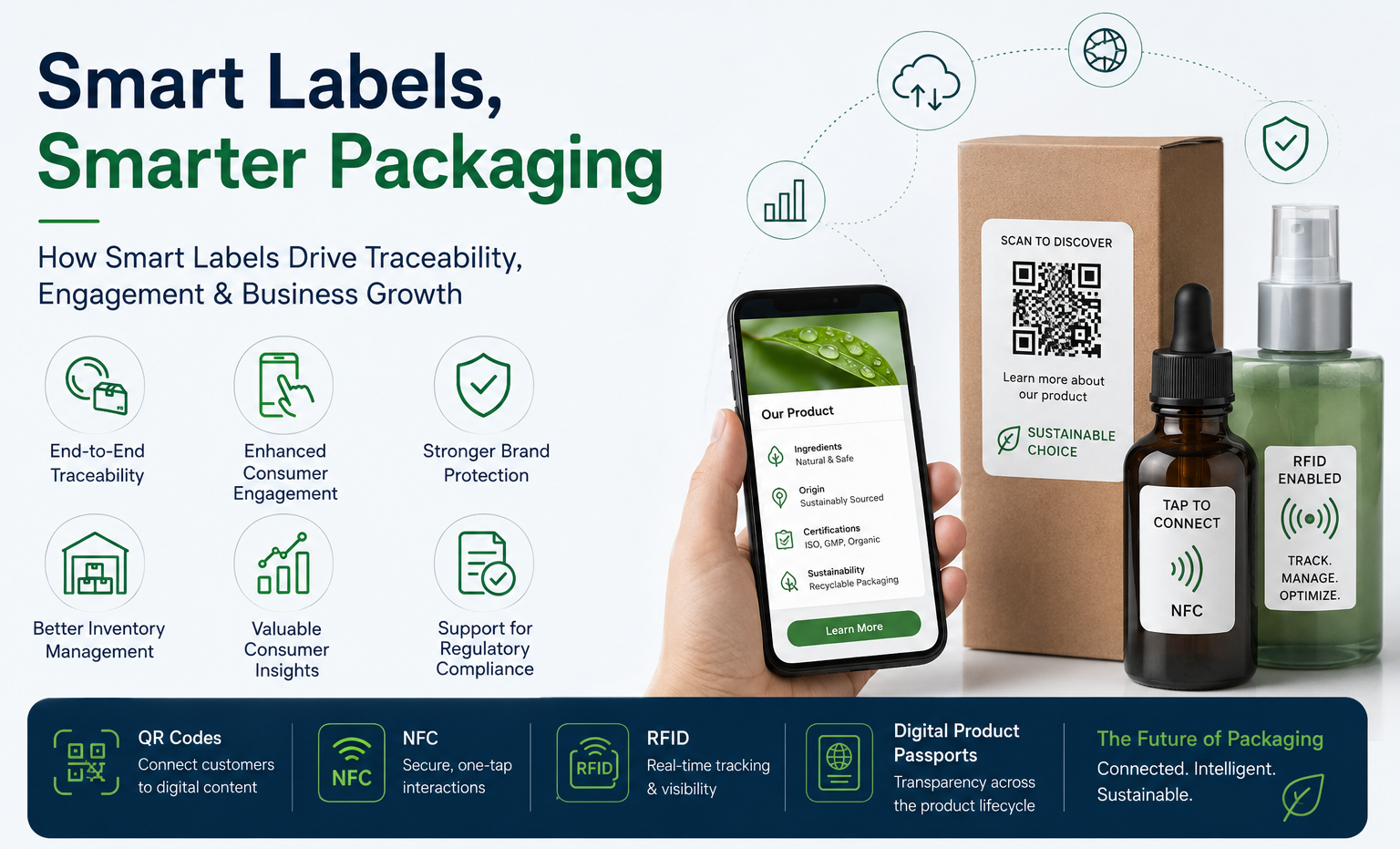
Today packaging does more than identify a product, it helps brands inform, engage, and build trust with consumers. As businesses seek better ways to improve transparency, product traceability, and customer interaction, smart labels have emerged as a valuable packaging innovation. By integrating digital technologies, these labels enable real-time access to information, support operational efficiency, and enhance the overall product experience.
With growing interest in connected packaging and sustainability-focused solutions, smart labels are becoming an increasingly important part of modern packaging strategies. This post discusses how smart labels work, their most common types, business benefits, sustainability impact, future developments, and how to determine the right solution for your needs.
What Are Smart Labels
Smart labels bridge the gap between physical packaging and digital information. These allow products to carry and deliver information beyond what is printed on the label itself. By incorporating technologies such as quick response (QR) codes, near field communication (NFC) chips, or unique serial identifiers, they enable instant access to product-specific data through smartphones, scanners, or connected systems. Depending on the application, smart labels can support inventory visibility, product authentication, supply chain monitoring, regulatory compliance, and customer interactions.
Types of Smart Labels Used in Modern Packaging
Different smart label technologies serve different business and operational goals.
-
Quick Response (QR) Code Labels:
QR code labels provide a simple and cost-effective way to connect customers with digital content. Easily scanned using a smartphone camera, they direct users to product information, instructional videos, promotional campaigns, loyalty programs, registration portals, and customer support resources. Their affordability, ease of implementation, and widespread consumer familiarity make them a popular choice for brands adopting connected packaging.
-
Radio Frequency Identification (RFID) Labels:
RFID labels are designed to improve product visibility and operational efficiency. Unlike traditional barcodes, they do not require direct line-of-sight scanning and can be read automatically from a distance, even across multiple items simultaneously. This makes them ideal for inventory management, warehouse operations, asset tracking, shipment verification, and supply chain monitoring, helping businesses improve accuracy and gain real-time visibility into product movement.
-
Near Field Communication (NFC) Enabled Intelligent Labels:
NFC labels create secure and personalized consumer interactions through a simple smartphone tap. Their ability to support direct, one-to-one communication makes them valuable for product authentication, warranty registration, digital product information, and customer engagement campaigns. NFC-enabled labels are widely used in luxury goods, electronics, cosmetics, and other premium products where authenticity and customer experience are key priorities.
-
Digital Product Passport (DPP) Labels:
DPP labels provide detailed information throughout a product’s lifecycle. They support transparency and compliance by giving users access to material composition, manufacturing origin, sustainability credentials, supply chain history, repair guidance, and recycling instructions. As sustainability and product transparency become increasingly important, these labels are gaining adoption across manufacturing, electronics, textiles, and consumer goods industries.
Key Benefits of Smart Product Packaging
Smart labels deliver value across the entire product lifecycle. Here are their key benefits:
- Improved Product Traceability: Smart labels help businesses track products throughout manufacturing, distribution, storage, and delivery processes. This enhanced visibility supports better supply chain management, improves accountability, and makes it easier to identify and resolve operational issues.
- Enhanced Consumer Engagement: Interactive packaging enables brands to connect directly with consumers through digital content and personalized experiences. By scanning a smart label, customers can access product details, educational resources, promotions, and other information that enhances their overall experience.
- Stronger Brand Protection: Smart labels can help combat counterfeiting by enabling product authentication and verification. This added layer of security helps protect brand reputation while giving consumers greater confidence in product authenticity.
- Better Inventory Management: Technologies such as RFID labels improve inventory accuracy by enabling faster and more efficient product tracking. Automated data collection reduces manual processes, minimizes errors, and supports smoother warehouse and supply chain operations.
- Valuable Consumer Insights: Smart labels provide businesses with data on customer interactions, including scan activity and engagement trends. These insights can help brands better understand consumer behavior and make informed marketing and product decisions.
- Support for Regulatory Compliance: Smart labels simplify access to important documentation, certifications, safety information, and traceability records. This can help businesses meet industry regulations while improving information accessibility for customers and stakeholders.
How to Choose the Right Smart Label for Your Application
The best smart label solution depends on your business goals and operational requirements.
- Define Your Objectives: Determine whether your primary goal is consumer engagement, product authentication, inventory management, product traceability, regulatory compliance, or a combination of these requirements.
- Evaluate Your Operating Environment: Consider where and how the label will be used. Factors such as temperature fluctuations, moisture exposure, abrasion, chemical contact, and product lifecycle expectations can affect label performance and durability.
- Understand Your Scanning Requirements: Consider who will interact with the label and how it will be scanned. Consumer-facing applications may benefit from QR codes or NFC technology, while warehouse and logistics environments often require RFID solutions for faster and more efficient tracking.
- Consider Data and Integration Needs: Smart labels are most effective when they integrate with existing business systems. Evaluate whether the solution needs to connect with inventory management software, ERP platforms, supply chain systems, or customer engagement tools.
- Select the Appropriate Technology: Choose the technology that best aligns with your goals. QR code labels are ideal for sharing digital content, RFID labels support inventory visibility and tracking, while NFC labels enable secure interactions and product authentication. Some applications may benefit from a hybrid approach.
- Evaluate Cost and Scalability: The right solution should fit both your current budget and future growth plans. Consider implementation costs, infrastructure requirements, and whether the technology can scale as product volumes and operational demands increase.
- Plan for Long-Term Growth: Select a smart labeling strategy that can adapt to changing business needs, customer expectations, and regulatory requirements. A scalable solution provides greater long-term value and reduces the need for future technology transitions.
Future Trends in Smart Packaging and Intelligent Labels
The future of packaging will be increasingly connected, data-driven, and consumer-focused. Several developments are shaping the evolution of smart product packaging:
-
Digital Product Passports Becoming Standardized:
Governments and industry bodies are working toward greater product transparency, which is expected to accelerate the adoption of digital product passports. These systems will allow businesses and consumers to access detailed information about a product’s origin, materials, sustainability credentials, repairability, and end-of-life handling through a single smart label.
-
AI-Powered Consumer Experiences:
As smart labels generate more interaction data, artificial intelligence may help brands deliver increasingly personalized experiences. Consumers may receive customized product recommendations, usage guidance, loyalty rewards, and support content based on their preferences and engagement history.
-
Integration with IoT and Smart Supply Chains:
Smart labels are expected to become more closely connected with Internet of Things (IoT) ecosystems. This integration will enable real-time monitoring, automated inventory management, predictive maintenance, and improved visibility throughout the supply chain.
-
Sustainability-Focused Labeling Innovations:
As circular economy initiatives gain momentum, smart labels will increasingly support recycling programs, material traceability, and sustainability reporting. Future solutions may provide consumers with more detailed environmental information while helping businesses meet evolving regulatory requirements.
-
Printable and Lower-Cost Smart Technologies:
Advancements in printed electronics and smart label manufacturing are expected to make technologies such as RFID, NFC, and sensor-enabled labels more affordable and scalable. This could expand adoption across a wider range of products and industries.
Build a More Connected Packaging Experience
PLCTX offers custom smart labeling solutions that help improve product visibility, streamline operations, and enhance customer experiences. Whether you’re launching a new packaging initiative or upgrading existing labels, our experts are ready to help. Get in touch with the team at PLCTX today.